Showing posts with label Fujifilm. Show all posts

Friday, March 8, 2024

Salish Sea Herring Spawn and Marine Mammals

On March 5 of this year, we braved the unseasonably cold weather and headed up to Comox, BC for a four-hour boat tour with Wild Waterways Adventures, in search of Biggs orcas and other marine mammals.  Our trip took us south to the Seal Islets north of Hornby Island, where we found a group of harbour seals hauled out on a small sand bar.


Harbour Seals (Phoca vitulina)


Harbour Seals (Phoca vitulina)

We then headed south through Lambert Channel between Denman and Hornby Islands, where we stopped for a few minutes to observe the seiner MV Nita Maria conducting a sample catch for the Pacific Herring Test Fishery near the south end of the channel.


MV Nita Maria


MV Nita Maria, Herring Test Fishery


MV Nita Maria, Herring Test Fishery


After watching the gulls flocking around the boat for a few minutes, we turned and headed east towards the south end of Hornby Island, where we found a large colony of California Sea Lions hauled out on the rocks at Toby Island.


California Sea Lions (Zalophus californianus) and Bald Eagles (Haliaeetus leucocephalus)


California Sea Lions (Zalophus californianus)


California Sea Lions (Zalophus californianus)


California Sea Lions (Zalophus californianus)


California Sea Lions (Zalophus californianus)


After a brief stop at Ford's Cove on Hornby Island for hot chocolate and snacks, we headed west past the Chrome Island lighthouse and turned north up the west side of Denman Island, but by then the weather had started to deteriorate and we didn't find much in the way of wildlife aside from a number of seabirds.  We headed back to Comox, cold but smiling, without having sighted any orcas but the trip was very enjoyable and informative all the same.

If you're looking to get out and see some of the fascinating marine life of the Salish Sea, I highly recommend Jen and Reuben at Wild Waterways Adventures.

Wednesday, May 24, 2023

Lock Bay Salt Marsh Birdwatching

One of the nicest spots for birdwatching this time of the year on Gabriola Island has to be the Lock Bay Salt Marsh adjacent to Sandwell Provincial Park.  This brackish tidal marsh is home to a number of bird species of waterfowl, wading birds, and songbirds, and vultures and bald eagles are often seen soaring overhead.  There are also a few resident river otters and beavers, should you be lucky enough to spot them.

I believe most of the marsh is private property, but there is a well-used public pathway that leads past the marsh just above the beach at Lock Bay.  Please use respect when visiting the park or the marsh.

Here are a few photos of birds I managed to capture on my last visit to the marsh - you can click on any of the images to see a larger version.


Lock Bay Salt Marsh, Gabriola Island


Great Blue Heron, Lock Bay Salt Marsh


Spotted Sandpiper (Actitis macularius)


Red-Winged Blackbird (Agelaius phoeniceus)


Red-Winged Blackbird (
Agelaius phoeniceus)


Canada Geese (Branta canadensis)


Song Sparrow (Melospiza melodia)


Mallard Ducks (Anas platyrhynchos)


Great Blue Heron (Ardea herodias)


All images were captured using a hand-held Fujifilm X-H2S digital camera and XF 100-400mm f4.5-5.6 R LM OIS WR zoom lens.  All images are Copyright © Cliff LeSergent.

Thursday, June 16, 2022

Fujifilm X-Trans Artifacts

There seems to be a lot of misinformation on the web regarding the cause (and cure) for the fractal artifacts that affect some images captured with Fujifilm's X-Trans sensor cameras.  The problem stems from the inability of some image processing software, notably products from Adobe such as Lightroom and Photoshop, to correctly interpolate the RAW data due to Fujifilm's use of a non-Bayer colour filter array over the image sensor.

This is an image captured with a Fujifilm X-T3 camera and processed in Lightroom:

Fujifilm X-T3, XF 10-24mm f4 @ 24mm, 1/210 sec @ f5.6, ISO 160

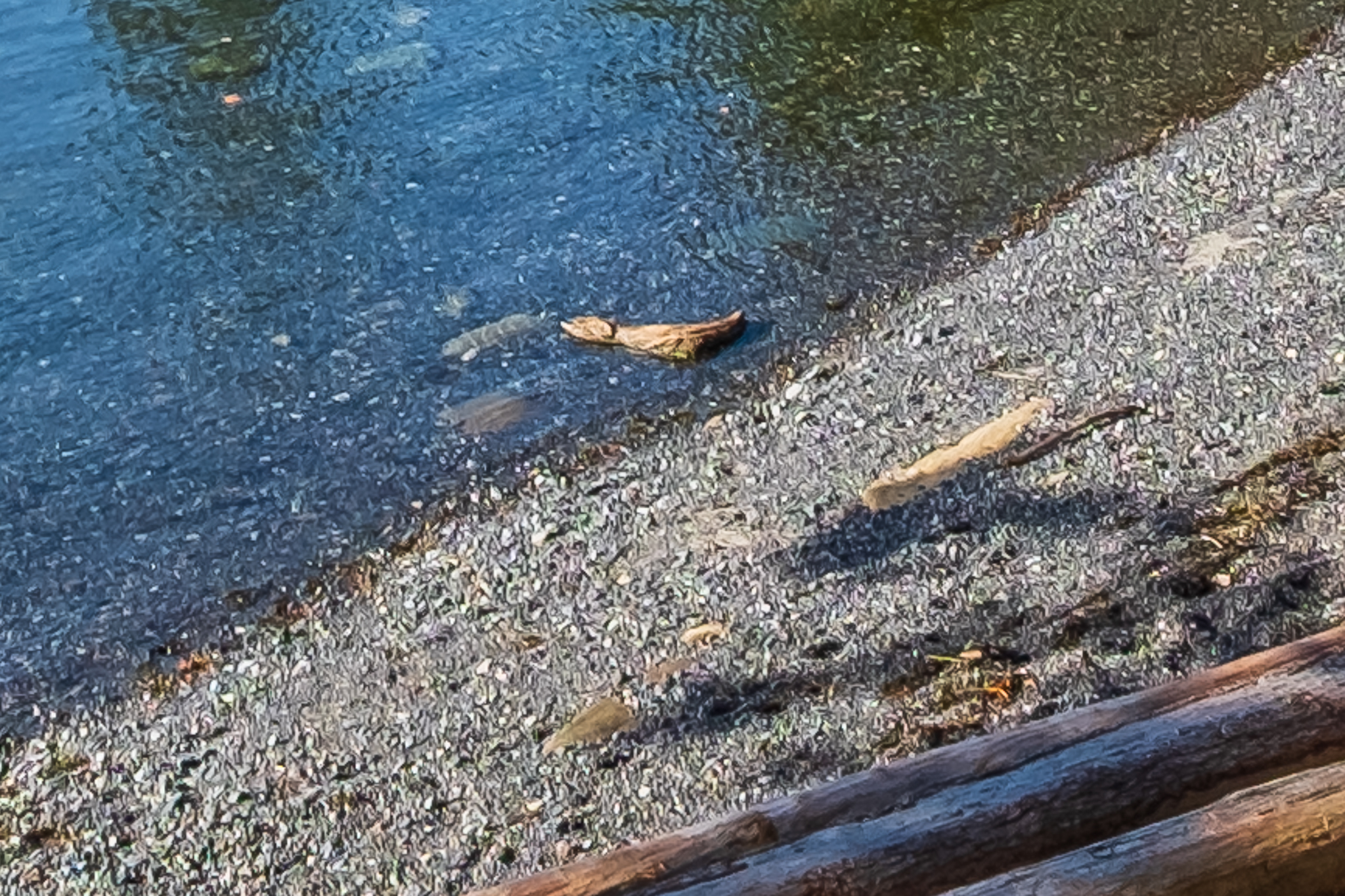
At first glance, the image looks quite nice; sharp, and with lots of rich colour the Fujifilm cameras are noted for.  However, on closer inspection, the fine details in the image, such as the pebbles on the beach, look strange and distorted:

100% crop of above image

At the limited upload size, it may be difficult to discern the artifacts, so here is a 200% crop of the same image:

Now the fractal artifacts are clearly visible, with the smooth round pebbles taking on a "wormy"appearance, with jagged edges and strange elongated proportions.  A popular "cure" for this issue is the set the Details slider to zero in the Lightroom sharpening panel:


As you can see, changing the details slider does little to correct the artifacts - virtually all it does is blur them a bit to make them a little less noticeable, but this also negatively affects all the other fine details in the image, make the image soft.

So, what is the best solution to this problem for Fujifilm X-Trans photographers?  I can't answer what is the "best", but the most obvious solution is to avoid using Adobe software for processing your RAW files, because the artifacts are clearly a manifestation of Adobe's demosaicing algorithm.  A popular alternative software is Capture One; below is the same image, processed in Capture One 21.


As you can see, the wormy Adobe artifacts are gone, although as in the examples above, we are still left with interpolation artifacts from enlarging the original image beyond actual size.

Finally, here is the original image, as processed in Capture One 21:


Wednesday, July 22, 2020

Back to the Fujifilm System

It's been a long time since my last post, but a lot has happened since then, both out in the wider world as well as in my camera bag. 

The global pandemic has shut down or delayed so many planned projects and kept us close to home for much of the year.  Surprisingly, I have taken more photos since the provincial health authorities shut things down in mid-March than I took all of last year, as I have been using the time to test and evaluate many different camera systems.  At the same time, I have been learning and evaluating new image processing software (Capture One Pro 20) which has also affected my choice of camera equipment.

After thorough reviews of all the images I have taken over the past five years using Canon and Nikon DSLR equipment, plus testing the latest cameras from Panasonic, Olympus, and Sony, I have come to the conclusion that my personal photographic wants and needs are best served by Fujifilm cameras and lenses, and I have returned to using their X-series (APS-C sensor size) and GFX (medium-format sensor size) cameras and lenses.  I will endeavour to elaborate on my choices in future posts.

In the mean time, here are some images from where we have spent much of the pandemic, in our own front yard...


Monday, October 30, 2017

L-Brackets and Remote Cables for the Fuji GFX 50S

I've been enjoying most aspects of the Fuji GFX 50S camera for my landscape photography, but some of the decisions by Fuji's designers have me scratching my head.  Fuji obviously understands that photographers will sometimes use the camera in the vertical ("portrait") orientation, since they wisely decided to make the rear LCD articulate in that plane.  However, they must not have considered that many serious photographers, myself included, use quick-release L-brackets for mounting the camera on a tripod.  

Fuji's decision to move the battery door to the left side of the camera means that the battery cannot be replaced without requiring tools to remove or reposition the L-bracket.  I initially purchased a Really Right Stuff L-bracket, being familiar with the quality products RRS normally produces.  The RRS L-bracket design is a clever two-piece arrangement with a screw that can be loosened to re-position the vertical portion of the bracket - unfortunately, it does not move far enough away from the body of the camera to allow the battery compartment door to open wide enough to remove the battery.

Really Right Stuff L-Bracket for the Fuji GFX 50S 
In order to change the battery, the user needs to completely remove the fastening screw and the vertical portion of the bracket.  I quickly discovered that re-installing the screw was a very fiddly procedure, and I dropped it numerous times while sitting at my desk trying to re-assemble the bracket.  I can only imagine how much more difficult this task would be out in the field, in cold rainy or snowy weather, and how easy it would be to lose the fastener.

RRS L-Bracket removed to access battery compartment

I returned the RRS L-Bracket, and ordered a bracket from Kirk Enterprises, which is a simpler, one-piece bracket, but the bracket can be loosened and moved far enough to the side to allow the battery to be replaced without removing the screw holding the bracket to the camera.  While this does mean carrying a smallAllen wrench to loosen and tighten the screw, it's a much less fiddly procedure than what is required with the RRS bracket.  The Kirk bracket has a clever holder in the bottom to store an Allen wrench, and I keep spares in all of my camera bags anyway, so I feel I'm much less likely to be inconvenienced while working in the field as I would if I lost the screw from the RRS bracket.

Kirk Enterprises BL-50S L-Bracket on the GFX 50S

Battery can be replaced without reming the Kirk L-Bracket


The other common issue with using an L-bracket is the placement of the ports for the remote control cable on the GFX.  The L-bracket needs to be moved away from the camera a considerable distance in order to attach the Fuji RR-90 remote cable, resulting in a somewhat top-heavy tripod head.

Fuji RR-90 Remote Cable attached to the GFX 50S

The Fuji RR-90 Remote requires a lot of clearance
Due to the size and configuration of the USB connector on the RR-90, it also requires that the Kirk L-bracket be loosened and re-positioned in order to attach the cable... which means digging out that Allen wrench again.

Fortunately, Fuji decided to give us not one, but two remote sockets on the GFX 50S.  The Fuji RR-90 connects (somewhat awkwardly) into the camera's USB3 port (at top right, in the photo below), but the camera also features a 2.5mm min-plug connector port for third-party remotes (the small round port at bottom left, below).  

Fuji GFX 50S Connection Ports


The remote I chose was the Canon RS-60E3, which features a right-angle mini plug connection.  It is small enough that with a bit of dexterity, it can be attached to the camera and removed again while the Kirk bracket is fixed in place, leaving the bracket positioned securely against the side of the camera for maximum stability.

Canon RS-60E3 Remote attached to the GFX 50S

Stable vertical shooting with the Kirk L-Bracket and Canon RS-60E3

Canon RS-60E3 (left) and Fuji RR-90 (right) Remote Release Cables

Canon 2.5mm mini-plug and Fuji USB connections

There are a number of third-party remotes available, but I chose the slightly more expensive Canon RS-60E3 because I find that the Canon remote cables tend to stay a bit more flexible in cold weather compared to some other brands.

Monday, October 9, 2017

Evening at Drumbeg with the Fuji GFX

One of my first outings with the new Fuji GFX 50S medium-format digital camera, at Drumbeg Provincial Park on the south end of Gabriola.  The amount of detail this camera can capture is astounding, and the colours and dynamic range are equally impressive.

One of my favourite spots for photography (or quiet contemplation) is Drumbeg Provincial Park at the south end of Gabriola Island.  There are some fascinating sandstone rock formations that are exposed at low tide, and I think they make very interesting subjects when the golden hour of sunset corresponds with low tide.

Click to view larger versions on black background

Gabriola Passage and Valdez Island

Oak Leaf in Pool, Drumbeg Provincial Park

Sandstone Shoreline, Drumbeg Provincial Park

Evening at Drumbeg Provincial Park, Gabriola 

(All images taken with Fuji GFX 50S and GF 23mm f4 WR lens)

Grasslands National Park and Southwest Saskathewan

 In late August I had a short trip to Calgary planned, and decided to tack on a few extra days and drive from there out to Grasslands Nation...